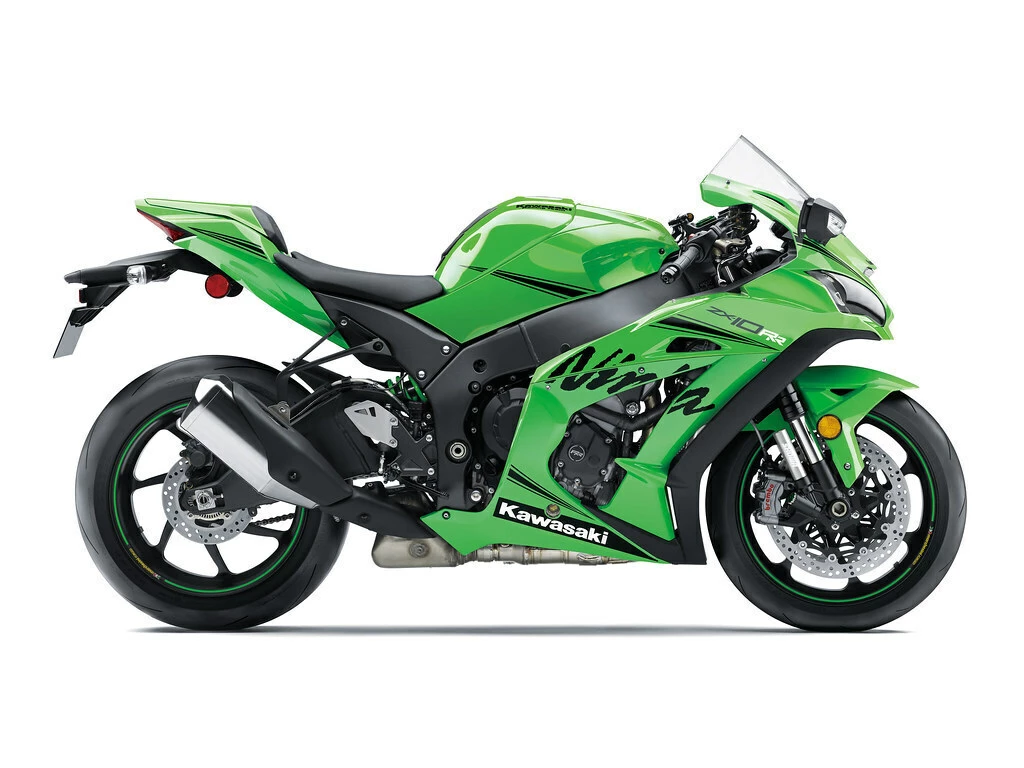

Ninja ZX-10RR (MY19) – Kawasaki
Original price was: $534.00.$95.99Current price is: $95.99.
- Service that stands out, online and always timely.
- Effortless Shopping, Quality Products
- Efficiency meets excellence in customer care.
- 100% High Quality Guarantee

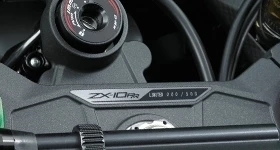
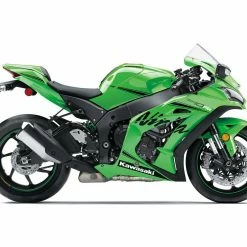
Based on the KRT race machine that has been amassing record after record in the Superbike World Championship, Kawasaki’s trio of litre-class supersport models allow a wide range of riders to experience the thrill of exploring their limits on the circuit. Engine improvements for 2019 Ninja ZX-10RR offer increased power, with an even wider power-band both advantages that that will further increase their race-winning potential. And the Ninja ZX-10RR – already one of the most potent track weapons in the paddock, and a proven championship winner receives tailor-made titanium connecting rods that benefit both engine and chassis performance, making it even more competitive. Limited-production (500 units worldwide) track-focused single seat model enhances the potential of the base model with further engine and chassis modifications, including titanium connecting rods, fine-tuned suspension settings, and forged Marchesini wheels.
ENGINE
A number of changes offering enhanced performance and increased reliability care of feedback from Kawasaki’s racing efforts in the Superbike World Championship facilitate converting the Ninja ZX-10RR into a race machine. A change to finger-follower valve actuation and other updates increase the Ninja ZX-10RR’s engine performance. Peak horsepower is higher: now 204 PS, which can easily be augmented care of a full race exhaust. However, the changes benefit performance across the rev range, delivering increased power at all rpm – an advantage for racers as well as World Superbike teams. The changes essentially raise the flat torque curve of the previous model, so the Ninja ZX-10RR’s easy-to-use character is maintained while offering increased power.
Complementing the new finger-follower valve actuation, the Ninja ZX-10RR features special high-performance titanium connecting rods designed by Pankl, a company specialising in developing and manufacturing engine and drive-train components for formula race cars, high performance vehicles and the aerospace industry. Their lightweight components, made from high-grade materials, are designed using finite element analysis to withstand extreme mechanical stress. These high-performance connecting rods were developed specifically for the Ninja ZX-10RR alongside the Kawasaki Racing Team’s long-time performance partner. The new cylinder head provides the clearance to accommodate race-kit high-lift cams. The high-rigidity crankcase offers excellent reliability and performance for a race-tuned engine.
SUSPENSION AND BRAKES
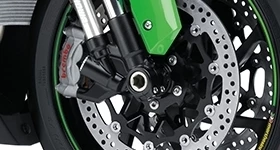
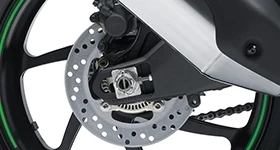
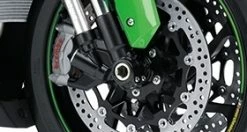
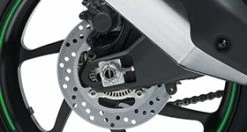
A pair of massive φ330 mm Brembo semi-floating discs with a thickness of t5.0 mm deliver superb braking force. The stainless steel rotors offer high rigidity and contribute to excellent brake feel. Special tuning at the Brembo factory ensures that all play has been removed from the system, so that when the brakes are called for, they respond immediately. At the rear a Brembo 220 mm diameter disc is slowed by a single-piston caliper. The disc’s round shape complements the round shape of the front Brembo discs. Steel-braided line is used for the rear brake as well, contributing to greater feel.
To match the Ninja ZX-10RR’s single-seat specification and wheels and tyres, front and rear suspension settings ensure smooth weight transfer during deceleration and acceleration on the circuit. Pitching is kept at a manageable level, resulting in composed behaviour. Complementing the Pirelli tyres, the suspension settings contribute to the bike’s quicker lap times.
FRAME
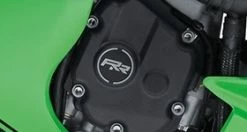
7-spoke multi-directional forged aluminium wheels jointly developed with Marchesini contribute to lighter handling – especially when changing direction. They offer a balance of high rigidity and a significantly reduced moment of inertia. In addition The Ninja ZX-10RR is fit with Pirelli Diablo Supercorsa SP tyres. Machined “RR” logo engraved into the pulser cover helps distinguish the Ninja ZX-10RR from the crowd. Ignition key adorned with a “RR” logo adds another special touch. Kawasaki’s electronic steering damper, jointly developed with Öhlins, is standard equipment on all models. Electronic steering damper provides just the right amount of damping based on what the bike is doing. Using input from the rear wheel speed sensor (provided via the engine ECU), the electronic steering damper’s ECU determines the vehicle’s speed as well as the degree the bike is accelerating or decelerating. For riders who prefer a mechanical steering damper, the race kit ECU can accommodate either the electronic or mechanical damper.
Be the first to review “Ninja ZX-10RR (MY19) – Kawasaki”
Related products


Reviews
There are no reviews yet.