




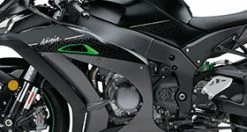
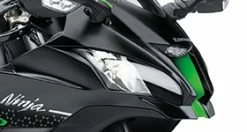
Ninja ZX-10R SE (MY18) – Kawasaki
Original price was: $452.00.$96.99Current price is: $96.99.
- Service that stands out, online and always timely.
- Effortless Shopping, Quality Products
- Efficiency meets excellence in customer care.
- 100% High Quality Guarantee

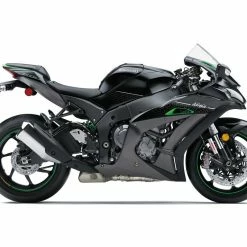
Complementing the original Ninja ZX-10R and track-focused Ninja ZX-10RR, Kawasaki proudly introduces a new high-grade edition to its litre-class supersport line-up for 2018. The Ninja ZX-10R SE features Kawasaki’s new, highly advanced electronic suspension. Both on the street and on the track, the suspension’s superb damping character offers a level of ride comfort that almost makes you forget you are riding a machine with race-ready suspension, while outstanding damping responsiveness delivers a planted feel that translates to rider confidence and further advances the ease of riding offered by the Ninja ZX-10R. Rest assured, the Ninja ZX-10R’s high circuit potential – as demonstrated by Kawasaki’s success in the Superbike World Championship – is undiminished: not only are experienced riders able to explore their limits, the new suspension enables a wider range of riders to get a taste of what it is like to ride Kawasaki’s World Superbike Champion machine. Comfort and Performance. The new Ninja ZX-10R SE really does offer the best of both worlds.
ENGINE
All-new in 2011, the Ninja ZX-10R SE’s engine balanced stunning power with manageability, and facilitated getting back on the gas by moving peak torque higher up in the rpm range. The new engine maintains this essential character, but offers a stronger low-mid range for increased acceleration coming out of corners.
Compact IMU operates in 6 DOF (degrees of freedom): 5 measured 1 calculated. Combined with Kawasaki’s proprietary dynamic modelling program, input from the IMU enables even more precise chassis orientation awareness, the key to bringing Kawasaki’s electronics to the next level.
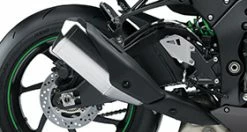
Exhaust header pipes, formed from heat-resistant titanium alloy, have almost the same length and diameter as their race-use counterparts. (This feature makes it easier for riders to increase exhaust performance (for track applications) without having to replace the entire exhaust system.) Connector pipe joins headers 3 and 4, contributing to smooth engine response. Header collectors (4-2 sections) are hydroformed, resulting in a simple, lightweight construction.
SUSPENSION AND BRAKES
Jointly developed with Showa, KECS adds electronically controlled damping to the high-spec Balance Free Front Fork and BFRC lite (Balance Free Rear Cushion) rear shock equipped on the Ninja ZX-10R. The semi-active system adapts to road and riding conditions in real time, providing the ideal amount of damping called for. Combining advanced, race-developed mechanical components with the latest electronic control technology, KECS offers both the suppleness to handle a wide range of street riding situations, and the firm damping needed for circuit riding.
Enhanced control of the Showa BFF front forks, comes thanks to a 1 millisecond reaction time produced by a solenoid valve with direct (single-stage) actuation. Quick reaction time is ideal for supersport applications such as track riding where a natural feeling is crucial to experience oneness with the bike. Built-in stroke sensors on both the front fork and rear shock provide real-time stroke speed and compression information every millisecond. Stroke speed and compression information is complemented by acceleration and deceleration information from the IMU, and vehicle speed from the FI ECU, every 10 milliseconds. Riders can chose from 3 modes: Road, Track and Manual. Road Mode: Delivers softer base settings to handle various street conditions. Track Mode: Delivers firmer settings for enhanced front-end feel and cornering. Manual Mode: Allows riders to tailor the rebound and compression damping settings to suit preference and/or riding style.
A pair of massive φ330 mm Brembo semi-floating discs with a thickness of t5.0 mm deliver superb braking force. The stainless steel rotors offer high rigidity and contribute to excellent brake feel. To further improve the Ninja ZX-10R SE’s corner entry performance on the circuit, a high-spec Brembo front brake system was implemented. The Brembo system – very similar to the system used on the Ninja H2R – includes the best components available for a mass-production model. Special tuning at the Brembo factory ensures that all play has been removed from the system, so that when the brakes are called for, they respond immediately.
FRAME
The centerpiece of the Ninja ZX-10R’s instrument panel is the highly visibly LED-backlit bar-graph tachometer. The tachometer also functions as a shift indicator: the LEDs will flash when the set rpm is reached. Riders can set the shift indicator rpm according to preference. The strength of Kawasaki’s cutting-edge electronics has always been the highly sophisticated programming that, using minimal hardware, gives the ECU an accurate real-time picture of what the chassis is doing. Kawasaki’s proprietary dynamic modelling program makes skilful use of the magic formula tyre model as it examines changes in multiple parameters, enabling it to take into account changing road and tyre conditions. The use of Bosch’s compact IMU allows an additional layer of precision to be added to the already high-level S-KTRC, KLCM, KECS and KIBS. Designed to assist racers by optimising acceleration from a stop, KLCM electronically controls engine output to prevent wheelspin and minimise wheelies when launching. Riders can choose from three modes, each offering a progressively greater level of intrusion. Each mode allows the rider to launch from a stop with the throttle held wide open. Hybrid predictive/feedback-type evolution of the highly sophisticated traction control system helps riders push harder by maximising acceleration. 5 modes enable expert riders to get even more serious enjoyment on the circuit. With the addition of the IMU, S-KTRC changes from a purely predictive system to one that also incorporates feedback. The new hybrid predictive/feedback system offers even more precise management to help an even greater range of riders experience riding at the limit. The 5 DOF input from the IMU (plus the 6th calculated by the ECU) complements the numerous parameters monitored by S-KTRC system. The Kawasaki Engine Brake Control system allows riders to select the amount of engine braking they prefer. When the system is activated (by selecting “L” (Light) in the “KEBC” settings), the engine braking effect is reduced, providing less interference when riding on the circuit. When activated, the “KEBC” indicator light on the instrument cluster will be illuminated.
Be the first to review “Ninja ZX-10R SE (MY18) – Kawasaki”
Related products


Reviews
There are no reviews yet.